

AI writes code. Almost for free.
Now everyone is asking what software is worth, starting with the people who spent years, or millions, building it.
Commercial open source companies have lived with that question for three decades. Their code has always been free to download, fork and run. Yet they built multi-billion-dollar businesses on top of it: Databricks, Confluent, Supabase, Mistral.
If anyone can teach us how to sell software when the code is free, it’s them.
So what exactly are they selling?
That’s the question behind The State of Commercial Open Source 2026, which we publish today with the Linux Foundation. I gave the first look in a keynote at Web Summit on Nov. 10th, and this post follows the talk.
From Why to How
This report is the second half of a two-part story. Last year, we asked the investor question: are open source companies actually good businesses? If not, why study them in the first place?
This year, we asked the founder question: how do they capture value from code they give away?
The 2025 edition answered the first question with a resounding yes. We tracked more than 800 VC-backed open source companies over 25 years against closed-source peers. They draw about $9B of venture funding a year, have an easier VC journey (across all dimensions), and exit at higher valuations 7× higher at IPO and 14× higher in M&A.
Which raises the question every founder asks me next: OK, but how? That data isn’t in any database. Funding rounds and exits are visible from the outside; business model choices, pricing and how a GitHub star becomes a contract are not.
So we asked the people running these companies. We surveyed 225 founders and business leaders of open source companies: 36% based in the US and 35% in the EU, from under $1M to over $100M in annual recurring revenue.
We focused on three questions:
Is AI good news for open source businesses?
If the code is free, what do customers pay for?
How do you turn users into buyers?
1. Is AI good news for open source businesses?
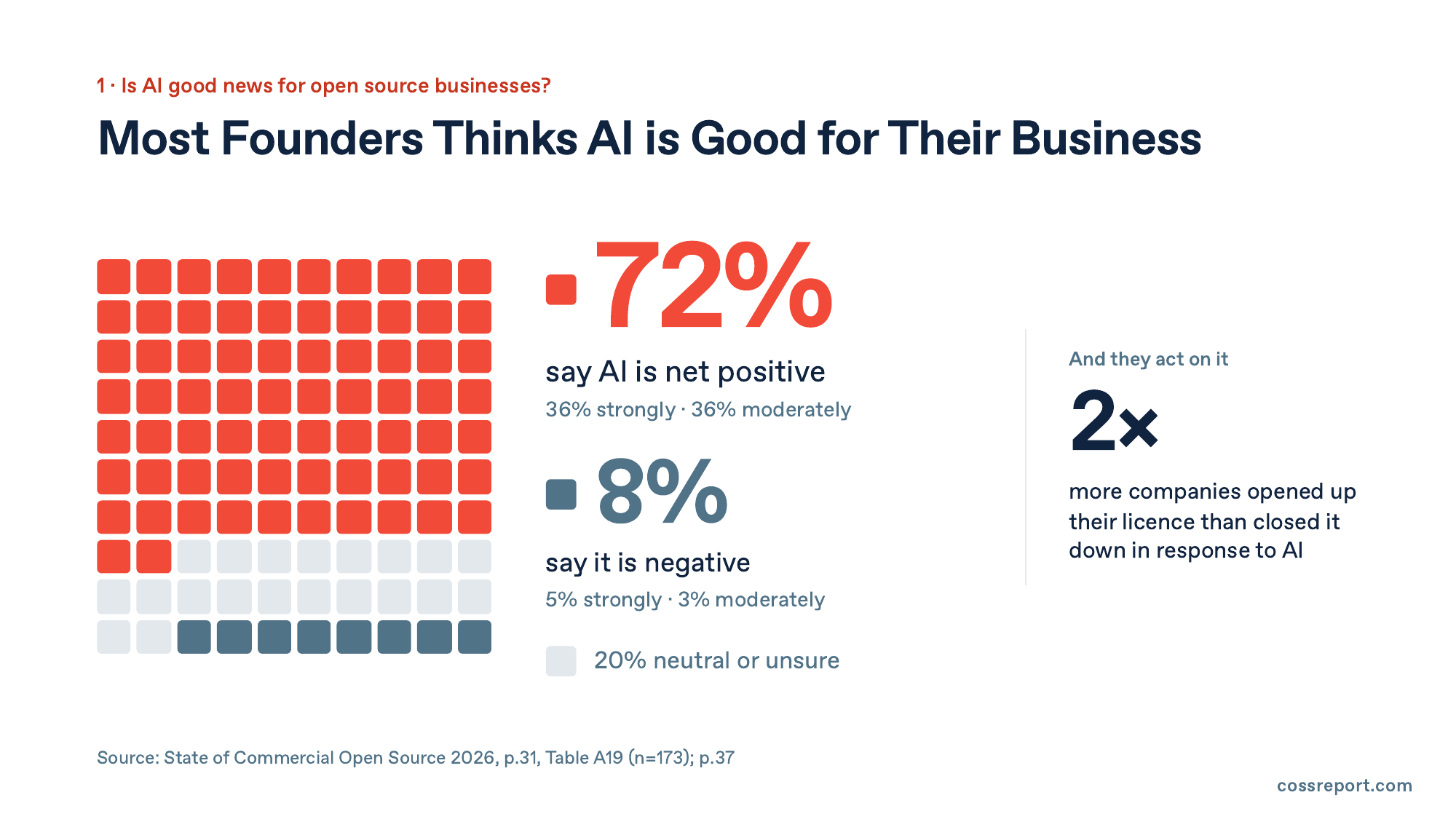
Most companies say yes. 72% report a net positive impact from AI on their business, half of them strongly positive. Only 8% report a negative one, and the remaining fifth are neutral. That’s a long way from the AI backlash you can read on the Hacker News front page every day.
And they act on it. You might expect open source companies to protect themselves from AI by locking their code down. The opposite is happening: 23% opened up more of their core product in response to AI, against 13% that made it more proprietary. Nearly twice as many opened up as closed down.
Why so optimistic? AI is a tailwind for infrastructure
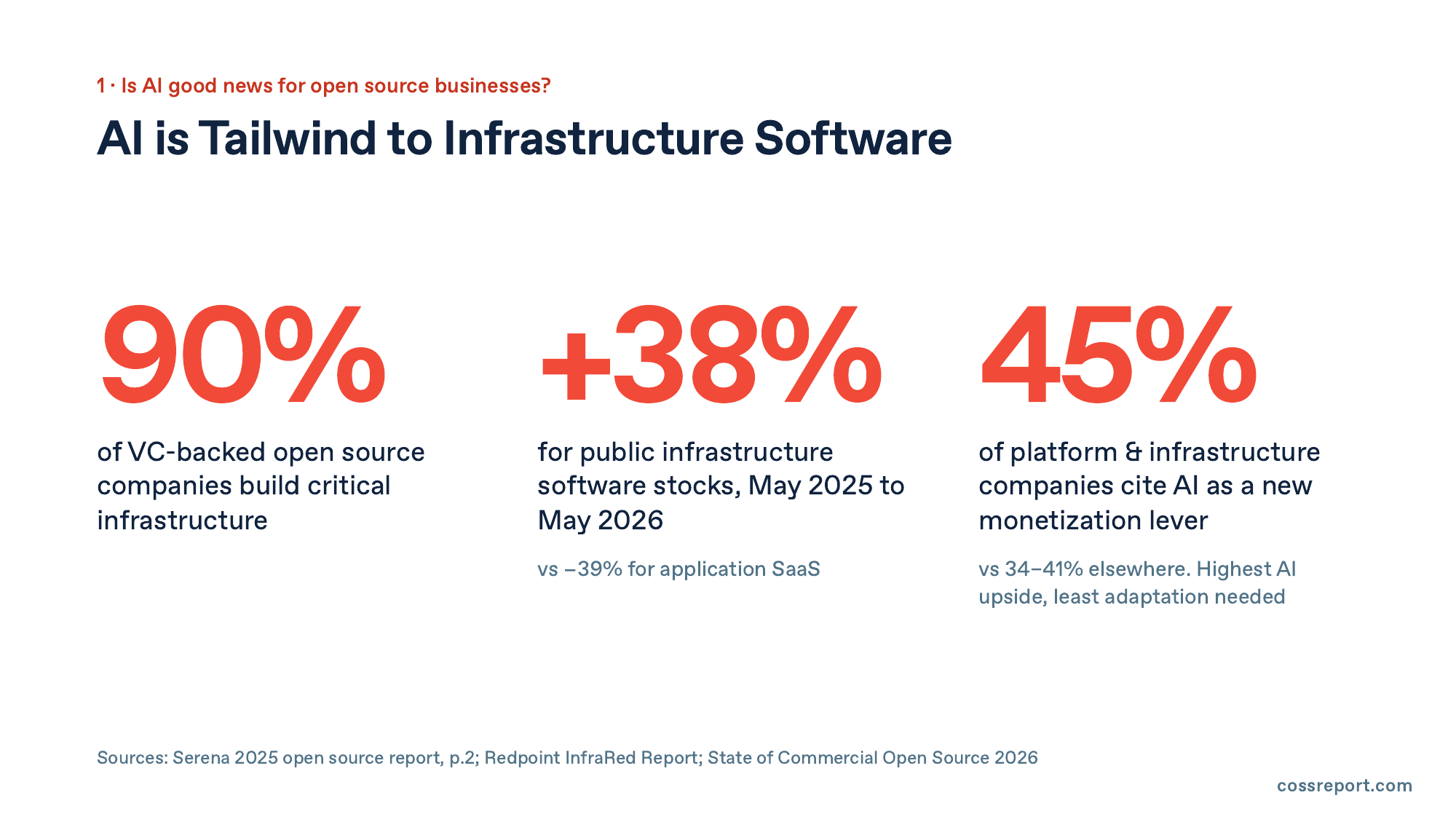
Open source is, overwhelmingly, an infrastructure business. Last year’s report found that about 90% of VC-backed open source companies build infrastructure: data, AI models and tooling, observability, developer tools, security.
The market has rewarded exactly that. Over the 12 months to May 2026, public infrastructure software stocks rose 38% while application SaaS fell 39% (source).
Infrastructure companies also see the clearest path to new revenue. 45% of platform and infrastructure respondents call AI a new monetization lever, the highest of any category (34–41% elsewhere). They get the most AI upside for the least adaptation.
Productivity first, revenue second
Ask how AI actually helps today, and the answer is mostly internal. Among companies that see a positive impact, 73% cite productivity: their own teams shipping faster. Fewer than half (46%) see a bigger market, and 39% see new revenue. AI-related roles are the only headcount category growing on net.
A word of caution: productivity is not a moat. If AI makes your team ship twice as fast, it does the same for your competitors, and those gains get competed away. Which brings us to the real question.
2. If the code is free, what do customers pay for?
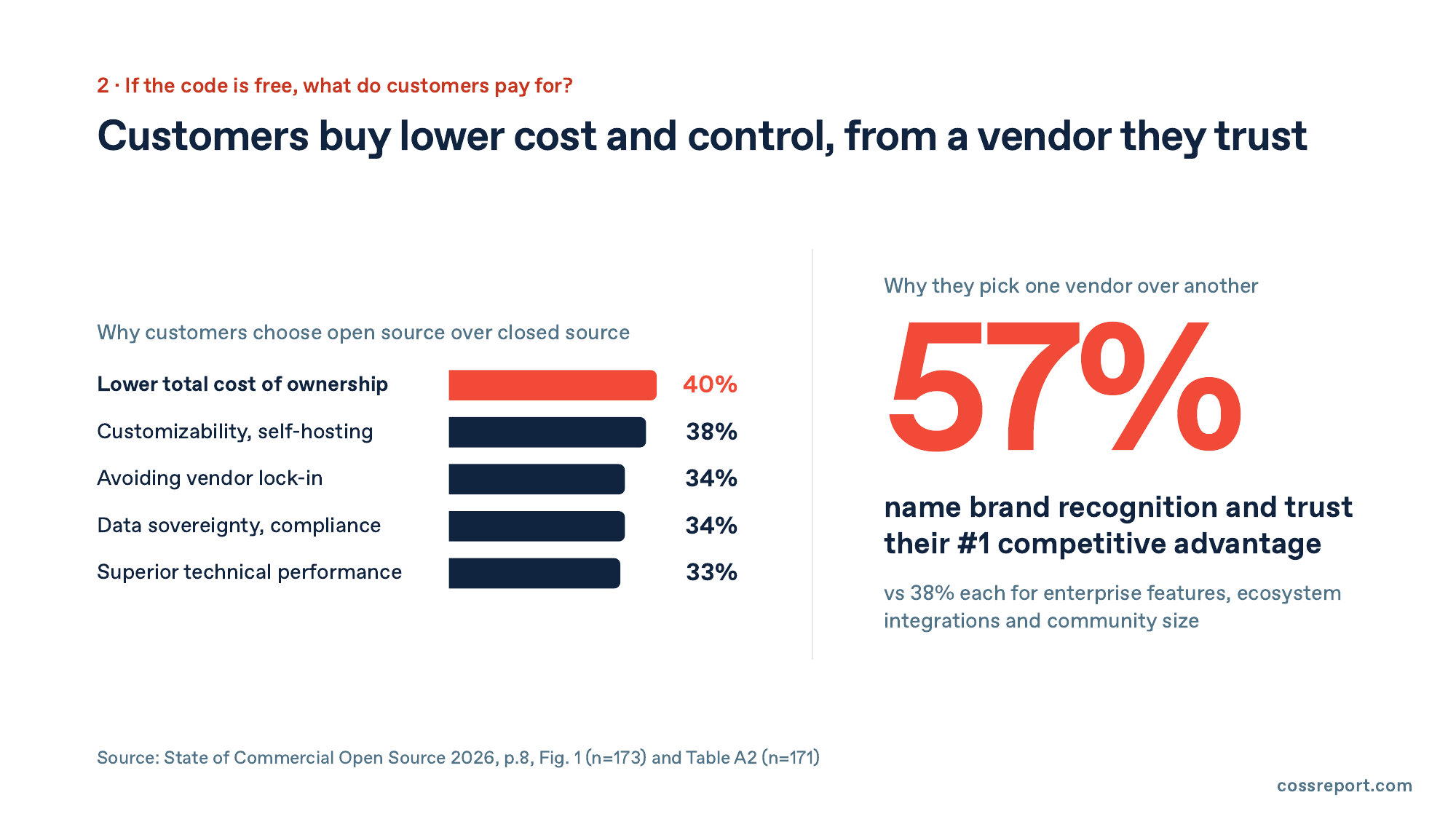
Start with why customers choose open source over a closed-source alternative. Lower total cost of ownership comes first, at 40%. Then come customizability and self-hosting (38%), avoiding vendor lock-in (34%) and data sovereignty (34%). That’s the same thing three times: control. Group them together and Control is the #1 reason why customer pick them.
And they buy control and lower TCOs from a vendor they trust. Asked what sets them apart from competitors, 57% of companies name brand recognition and trust, far ahead of enterprise features or ecosystem integrations. It may be the most important number in the report: the #1 competitive advantage of an open source company is trust, not code.
Four ways to get paid, and only one sells code
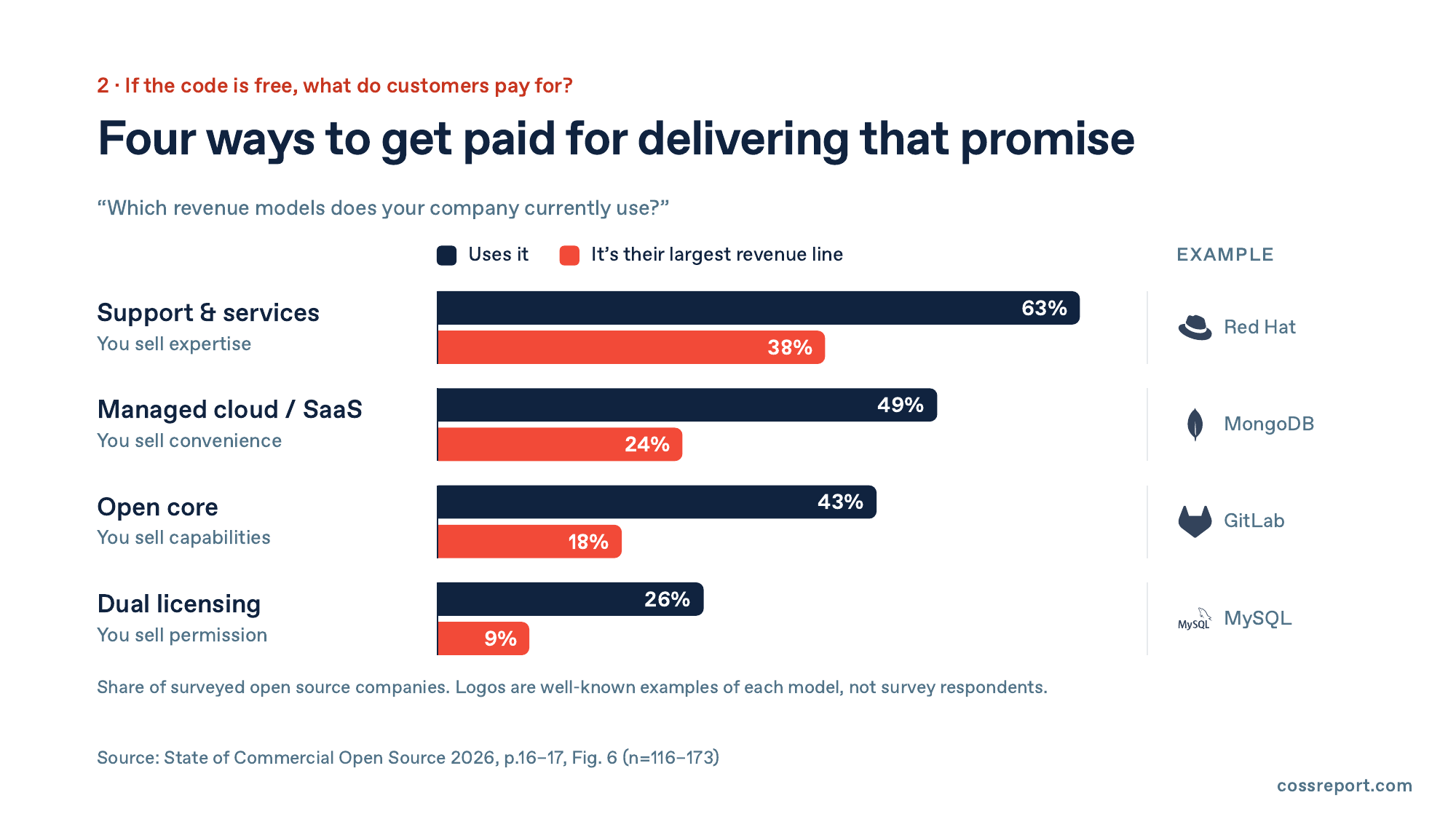
A founder has four main ways to get paid for delivering on that promise:
Support and services
Managed cloud
Open core
Dual licensing
Support and services is the most widely used (63%) and most often the largest revenue line (38%). It’s the easiest to sell, but it’s also the less scalable. Open core, the one model that sells code users don’t have, is the largest revenue line for just 18%.
Companies don’t pick a business model, they stack them
The median company runs two revenue models, and a third run three or more. Only 19% of open core companies run it as a pure play.
So if you’re agonizing over whether you’re an open core company or a cloud company: stop. You don’t have to choose; you’ll probably end up doing both.
Support stays sticky across stages, at around 60%, while managed cloud climbs from 35% of companies below $5M ARR to 66% above $20M.
VC-backed companies are more likely to run open core (53% vs 38%) and less likely to sell support (47% vs 63%). No surprise: VCs want software margins and revenue that grows faster than headcount. When open core works, it can deliver that.
It does not mean you should not provide support & services if you’re VC-backed or aiming for scale. Support & services are a great tool to generate enterprise leads, entering account (it’s easy to sell) and for retention purpose.
Open core charges for enterprise needs
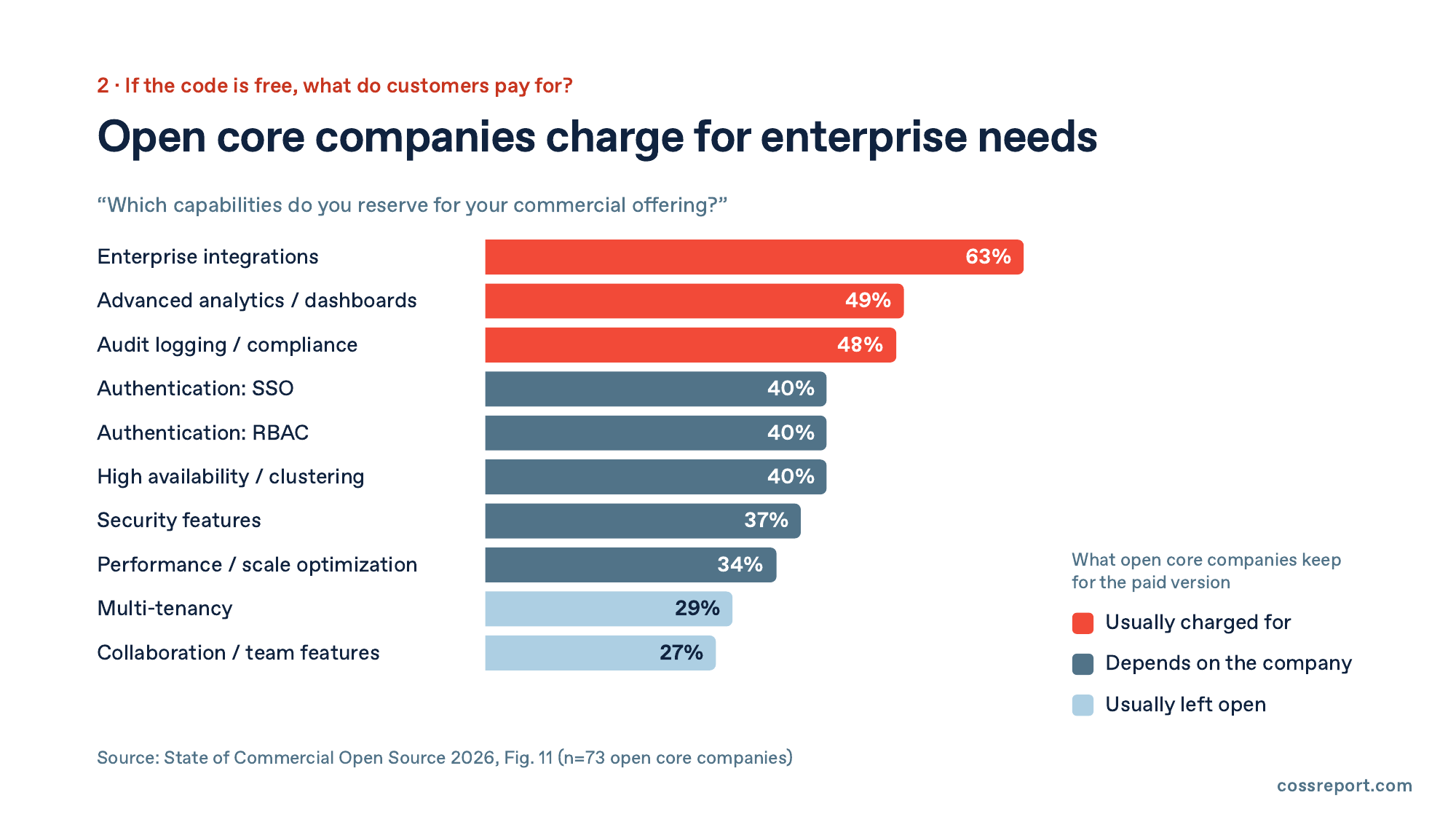
Open core companies hold back what an enterprise needs: enterprise integrations and SLAs (63% each), advanced analytics (49%), audit and compliance (48%), then SSO, RBAC and high availability (40% each). None of these make the product better for the developer. They make it safe for the company.
Collaboration features are the least gated (27%): you don’t charge for the very thing that spreads your tool.
The rule of thumb: keep open what the developer needs, and charge for what the executive buyer needs.
3. How do you turn users into buyers?
Thousands of GitHub stars means adoption. But adoption doesn’t sign contracts, someone with a budget does.
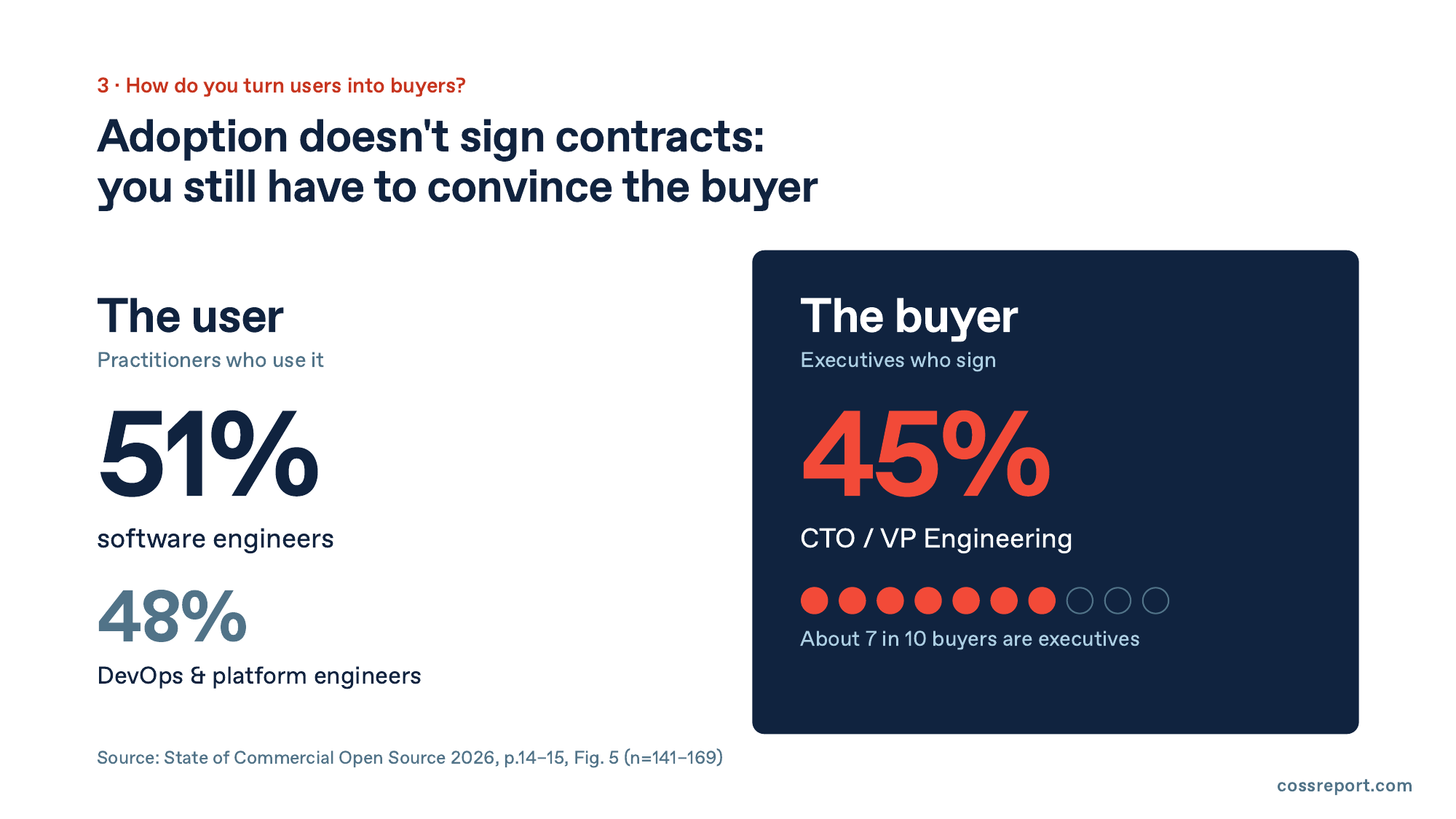
That’s the central challenge of open source go-to-market: the person who uses the product and the person who buys it are two different people, and they respond to two different value propositions. Users are practitioners, mostly software engineers (51%) and platform engineers (48%). The open code is what draws them in, and their reward is the first layer of value: an engineering job done. They’re also the first one to interact with the product.
Buyers are executives, about seven in ten of them, with the CTO or VP of Engineering signing in 46% of cases. They buy ROI and the control and lower TCOs we’ve mentioned. The split holds at every revenue stage.
And you need this business case when the practioner comes with the ask to the buyer.
Only sales wins the buyer
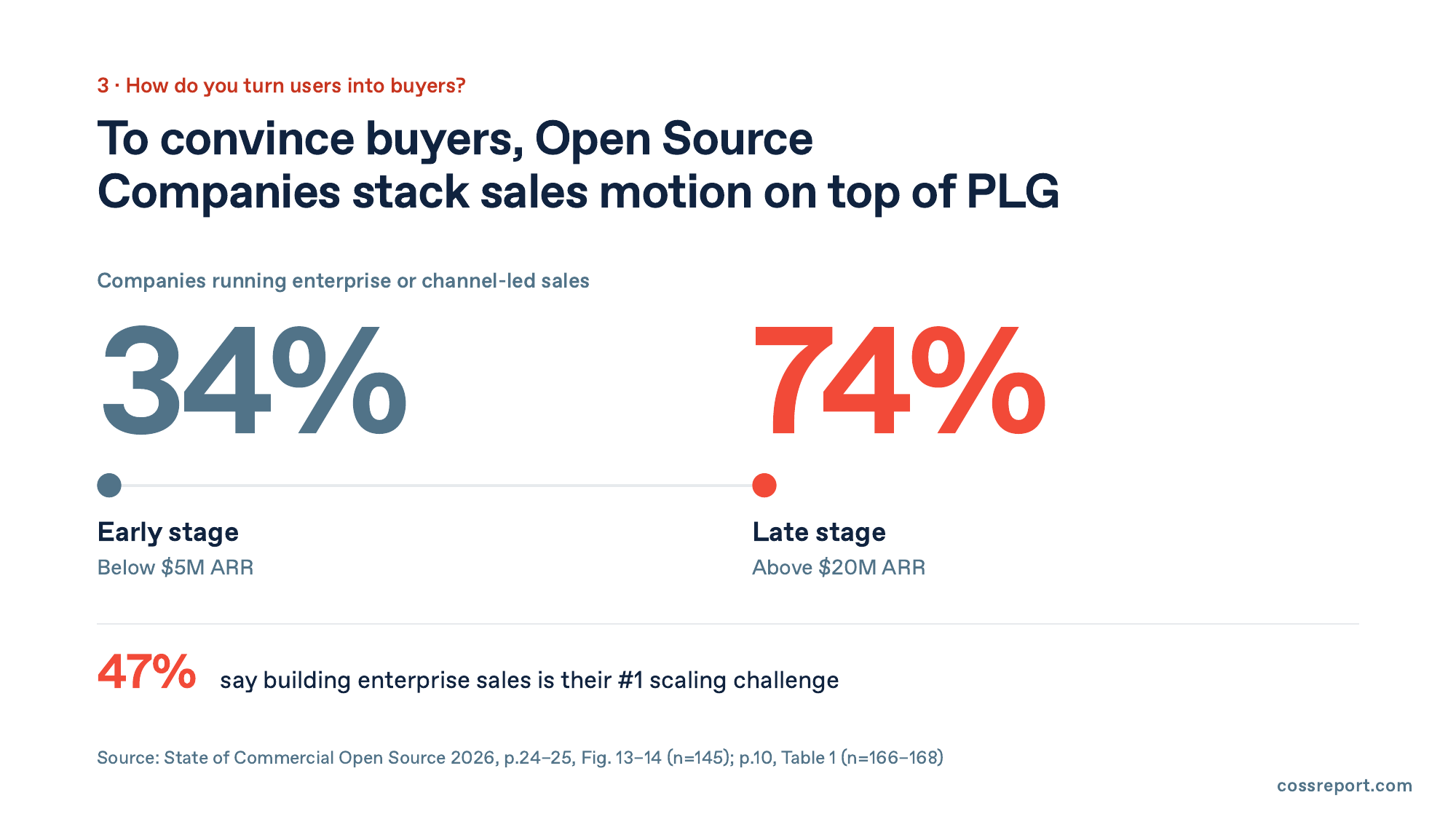
For the technical founders who are allergic to salespeople, I have bad news: only sales wins the buyer. As they scale, companies add a sales motion on top of product-led growth, whether enterprise sales, inside sales or channel partners. 34% of companies below $5M ARR run enterprise or channel-led sales. Above $20M, 74% do.
Product-led growth never goes away. It holds at around half of companies at every stage and, together with the community, it’s what drives adoption. What changes is the sales capacity built around it.
That capacity is the hardest part. Building enterprise sales is the most cited scaling challenge (47%) and the top priority for the next two years (45%).
Pricing stacks too
Pricing follows the same logic: companies layer mechanisms rather than pick one religiously. Early on, they lean on simple tiers. Later, they add pricing that grows with customer usage: usage-based pricing rises from 35% of companies below $5M ARR to 52% above $20M, flat-rate from 18% to 39%, seat-based from 27% to 36%.
2-5% conversion rate
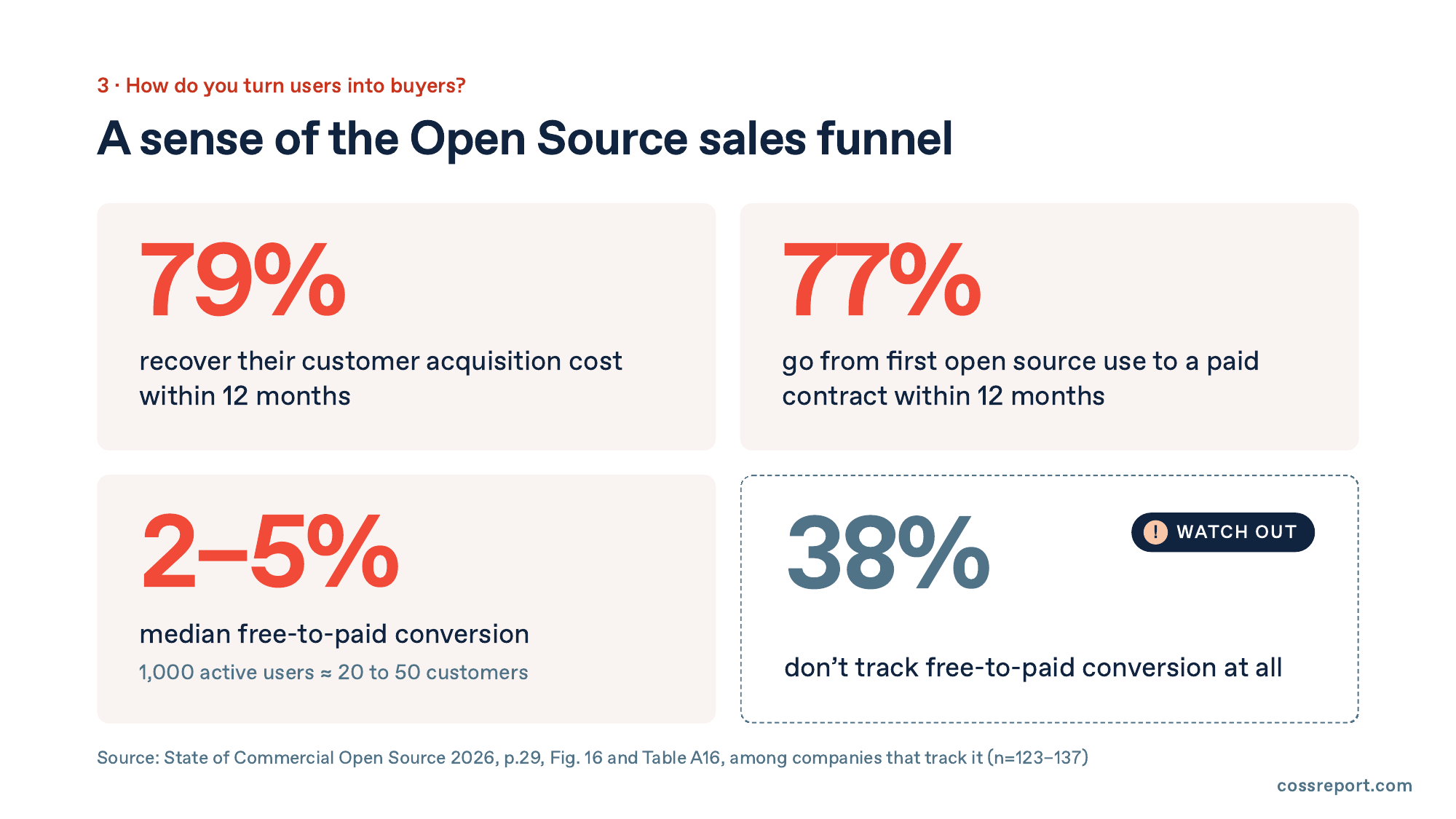
How many free users can you expect to convert? Among companies that track it, the median free-to-paid conversion rate is 2–5%: for every 1,000 users, 20 to 50 customers.
It’s also fast. Among companies that track these metrics, 77% go from first open source use to a paid contract within 12 months, and 79% recover their customer acquisition cost within 12 months.
One warning: 38% of companies don’t track free-to-paid conversion at all, 42% don’t track time to first contract, and 25% don’t track CAC payback. If you’re a founder, start tracking them. It’s how you’ll know whether you’re on track to build a great business.
Wrapping it up
Is AI good news for open source businesses? Yes. 72% call it a net positive, and companies are opening up more, not less.
If the code is free, what do customers pay for? Lower cost and control, from a vendor they trust.
How do you turn users into buyers? Developers adopt, executives buy. Companies layer enterprise sales on top of product-led growth, and that’s the hardest part to build.
AI writes code, almost for free. That’s scary if you think code is what you sell. Open source companies never sold the code, and that’s a useful lesson for every software company right now.
One last thought: open source won the developer; next, it will win the agent. Agents are about to become the biggest users of open source, and like humans, they pick what is open, proven and trusted.
I’m convinced the founders who build and price for those new users will define the infrastructure of the AI era. If that’s you, we should definitely have a conversation.
Acknowledgement
Huge thanks to my co-authors, Sam Boysel (Linux Foundation) and Anni Lai (LF AI & Data), to our sponsors AWS, CNCF, Futurewei and Red Hat, without whom this year’s research would not exist, and to every partner who helped distribute the survey.
Above all, thank you to the 225 founders and leaders who told us how they actually run their companies.